DNA match to Moore line – but not our Y-DNA Moore line
Accurately identifying and verifying an ancestor is a lot of work including scouring public and family records and DNA results. This post shares a brief case study, stresses the importance of verifying ancestors, and explains how we proved one ancestor. This case study also demonstrates why we use both traditional and DNA research tools to verify ancestors.
Hundreds of years ago, a person’s life span was much shorter. Just 120 years ago, the average life span of an American was 47 years (Schmerling, 2022). People married to survive, families took in orphans (whether or not legally adopted), and birth control didn’t exist. Records may indicate parents and family members where there is no blood relation (called a non-parent event, NPE). It’s not our place to judge; as genealogy researchers, we only focus on accurately verifying ancestors. In prior centuries, times were different: people took care of one another the best they knew how. It’s important to not evaluate a family based on today’s resources and culture.
Several cousins in our family have taken Ancestry’s autosomal DNA tests and FamilyFinderDNA’s autosomal, Y-DNA, and MtDNA tests. Those results confirm DNA matches but don’t explain relationships. Ancestry offers a tool called Thrulines that scours the trees of DNA matches, looking for possible ancestors and relatives. Accuracy of the trees of DNA matches can varies substantially. Still, DNA shows there is a match.
For years we’ve worked on our Moore ancestors – a challenge exacerbated by name’s commonness. Our earliest confirmed Moore ancestor is George Wesley Moore, died 1817 in Rutherford County, North Carolina. We have confirmed he is our ancestor based on wills, census records, land deeds, and multiple DNA connections to a handful of family DNA test takers.
We were intrigued to see a Thru Line hint for Rebecca Moore born 22 July 1829 in the US and died 29 Nov 1897 in the US. According to her marriage license, she married Abraham Moore on 24 Nov 1835 in Edgecombe, NC, who appears to be her first cousin. Her parents were Samuel Moore (died 1835, documented by will) and Purity Piety Lancaster Moore (born 1790 in North Carolina and died 1880 Edgecombe County, NC). With all of those Moore surnames and a DNA match, we were thrilled to find this connection!
Samuel’s brother was a name we had run across before – Etheldred Moore (born 1780 and died 6 Jun 1840 Edgecombe, NC) – and their father was William Elijah Moore, born 1755 and died 1833, all in Edgecombe, NC. Further research found that William Elijah Moore’s father was James Moore (1729-1789) and his grandfather was Joseph Berringer Moore (1694-1757). We had extensively researched the Berringer name before and know that line to be connected to James Moore (and his son James), both of whom were governors of North Carolina in the 1700s. We know from Y-DNA that our donors are not related to this James Moore line.
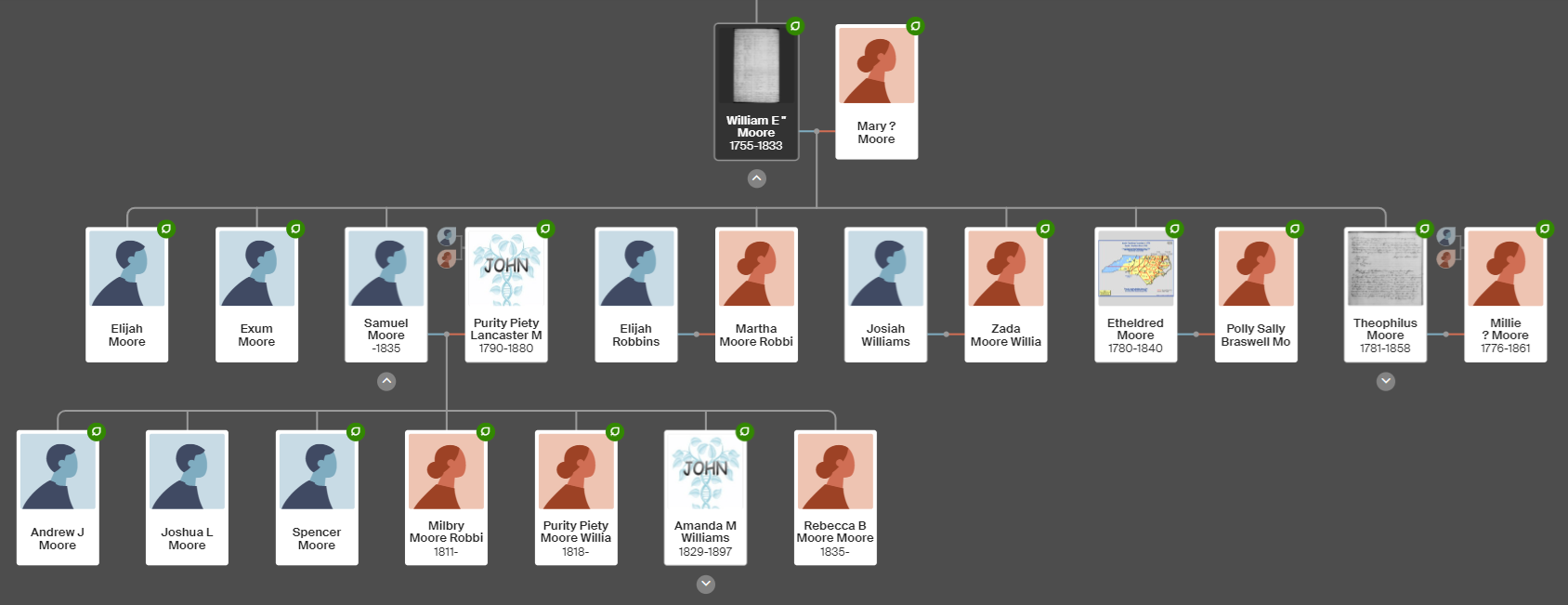
Amanda Moore and her father Samuel Moore were DNA connections to one of our Ancestry DNA donors (who had also taken the Y-DNA test) and we had other ancestors near Edgecombe. Y-DNA tracks the Y chromosome from father to son for endless generations; we had previously compared the Y-DNA results and knew that the Gov. James Moore line was not our biological line (different haplogroup). Yet this Thru Line hint and documentation showed a DNA connection through Samuel Moore (died 1835).
Further digging showed that our same Ancestry DNA and Y-DNA donor had Lancaster ancestors. He (and we) are related to Amanda Moore Williams on her mother’s Lancaster side, not through her father’s Moore side. Our donor is related to Samuel Moore, not through Samuel’s Moore ancestors but through his wife’s Lancaster ancestors.
When our donor took the Y-DNA test, we joined the Moore surname project. But many of our Y-DNA matches were Howard. We found that, sometime before 1600 and possibly before the use of surnames, one of our earliest male Moore ancestors was fathered by a Howard. So we joined the Howard surname project that have confirmed this is our biological Y-DNA line.
References
Howard (n.d.). Howard. Family Tree DNA. https://www.familytreedna.com/groups/howarddnaproject/about
Moore Y-DNA Project (n.d.). Moore Y-DNA Project. Family Tree DNA. https://www.familytreedna.com/groups/moore/about
Schmerling, R. H. (2022, Oct. 20). Why life expectancy in the US is failing. Harvard Health Publishing. https://www.health.harvard.edu/blog/why-life-expectancy-in-the-us-is-falling-202210202835#:~:text=With%20rare%20exceptions%2C%20life%20expectancy,risen%20to%20nearly%2079%20years.
 My Roots Genealogy