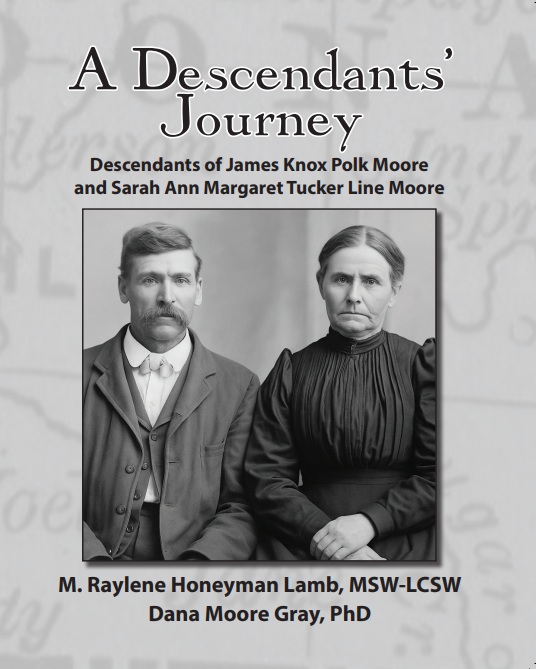
Pre-orders are being accepted for the upcoming publication of A Descendants’ Journey: Descendants of James Knox Polk Moore and Sarah Margaret Tucker Line Moore. Publication of the 214-page book is scheduled for December 1, 2025. Click here for more information.
Many researchers have confused the parents of John Tucker. It’s easy to do for many names that belong to multiple people in the same era and geographic location.
In this case, our earliest known and documented Tucker was John Tucker, born 1765 in Maryland and died 1855 in Indiana, married Sarah Sally Richardson. This is documented by the will of John’s father-in-law John Richardson. We refer to this John as John Tucker Ours.
John Tucker Ours was a different person that the John Tucker who was the son of Seaborn Tucker, as evidenced by lack of DNA matches and census records. While John Tucker ours may be related to the Seaborn Tucker line, his father was not Seaborn Tucker.
Below is the evidence.
Seaborn Tucker (1672-1753) married Dorothy Ann ? Harrington Tucker (her first husband was Harrington). This is documented by Baltimore County Families and Maryland US Wills and probate records, and Colonial Families of Anne Arundel by Robert Barnes.
They had a son named John Tucker (1698-1757) born and died in Arundel County, MD. He and his wife Martha Cobb were the parents Seaborn Tacker/Tucker, 1742-1805, who married Elizabeth Hitchcock. This is evidenced by will of John Tucker (1698-1757) and Seaborn Tucker’s will (1705) and will of Seaborn Tucker died 1757 in Anne Arundel County, MD).
Seaborn Tacker/Tucker married Elizabeth Hitchcock. Seaborn Tacker/Tucker was born 1742 in Maryland died 1805 in Rowan County, NC, evidenced by his father’s will written 24 Dec 1805. Signed his will with a mark, no signature.
One of their children was John C Tucker (1776-1852) not to be confused with John Tucker (ours) who died in Indiana. John C Tucker was born in MD 1776 and died in Giles County, TN 24 Feb 1852, evidenced by FindAGrave, marriage records, 1820 1840 1850 census records. This John was married to Elizabeth Evans and they went by the surname of Tacker.
Cousin fishing is a term referring to comparing the family trees of possible relatives. The strategy is enabled by genealogy platforms including Ancestry or FamilySearch who provide access to members’ public trees with possible shared ancestors. While cousin fishing can be extremely useful, particularly for cousins that share DNA, possible matches must be fully vetted for accuracy and documentation, and analyzed for logical time, place, and connections.
Consider our direct ancestor is George Moore who died 1817 in Rutherford, North Carolina. We have not yet proven his parents, birthdate, birth location, or the name of first wife who was the mother of his four children (per his will): Rebecca Sally Moore Fletcher, James C Moore, Joseph Moore, and Lemuel Moore.
We have proven that George Moore is our ancestor based on triangulation of multiple DNA matches, George’s will, and documentation of his children (including their wills). His last (and presumed second) wife was Elizabeth ? Hawkins Moore, 1750-1819, documented by her will that names the grandchildren of her son from her first marriage to William Hawkins.
Yet we frequently see research from possible cousins listing George’s first wife as Martha V Roster – without documentation. This information has been shared and spread online without documentation other than a single record that appears to be for a different couple. The international marriage record lists Martha V Roster, daughter of Captain Daniel Brown Jr and Fanny Flowers Webb (not Roster?). The international marriage record lists George M Moore, born 1740 in England, marrying a woman named Martha (last name unknown), also born in England in 1740 (Yates Publishing, 1740). George M Moore and Martha V Roster (nee Brown) were married in Virginia, date unknown. So far we have found three George Moores who lived in North Carolina in the late 1700s and early 1800s. Of those three, one was our ancestor who died 1817, one was George M Moore who MAY be part of the SC Governor James Moore line, and a third Moore line that apparently emigrated from Ireland.
We continue to research George M Moore from this record. He may be part of the same family or an entirely different Moore line. We also continue to research Martha Roster (nee Brown) who apparently was a widow by the time she married her George.
The lesson? Embrace leads but fully vet and analyze. Don’t accept at face value without doing the work to confirm and verify. My Roots Genealogy gladly looks at leads but follows strict practices to verify, document, and analyze before accepting hints as evidence.
DNA match to Moore line – but not our Y-DNA Moore line
Accurately identifying and verifying an ancestor is a lot of work including scouring public and family records and DNA results. This post shares a brief case study, stresses the importance of verifying ancestors, and explains how we proved one ancestor. This case study also demonstrates why we use both traditional and DNA research tools to verify ancestors.
Hundreds of years ago, a person’s life span was much shorter. Just 120 years ago, the average life span of an American was 47 years (Schmerling, 2022). People married to survive, families took in orphans (whether or not legally adopted), and birth control didn’t exist. Records may indicate parents and family members where there is no blood relation (called a non-parent event, NPE). It’s not our place to judge; as genealogy researchers, we only focus on accurately verifying ancestors. In prior centuries, times were different: people took care of one another the best they knew how. It’s important to not evaluate a family based on today’s resources and culture.
Several cousins in our family have taken Ancestry’s autosomal DNA tests and FamilyFinderDNA’s autosomal, Y-DNA, and MtDNA tests. Those results confirm DNA matches but don’t explain relationships. Ancestry offers a tool called Thrulines that scours the trees of DNA matches, looking for possible ancestors and relatives. Accuracy of the trees of DNA matches can varies substantially. Still, DNA shows there is a match.
For years we’ve worked on our Moore ancestors – a challenge exacerbated by name’s commonness. Our earliest confirmed Moore ancestor is George Wesley Moore, died 1817 in Rutherford County, North Carolina. We have confirmed he is our ancestor based on wills, census records, land deeds, and multiple DNA connections to a handful of family DNA test takers.
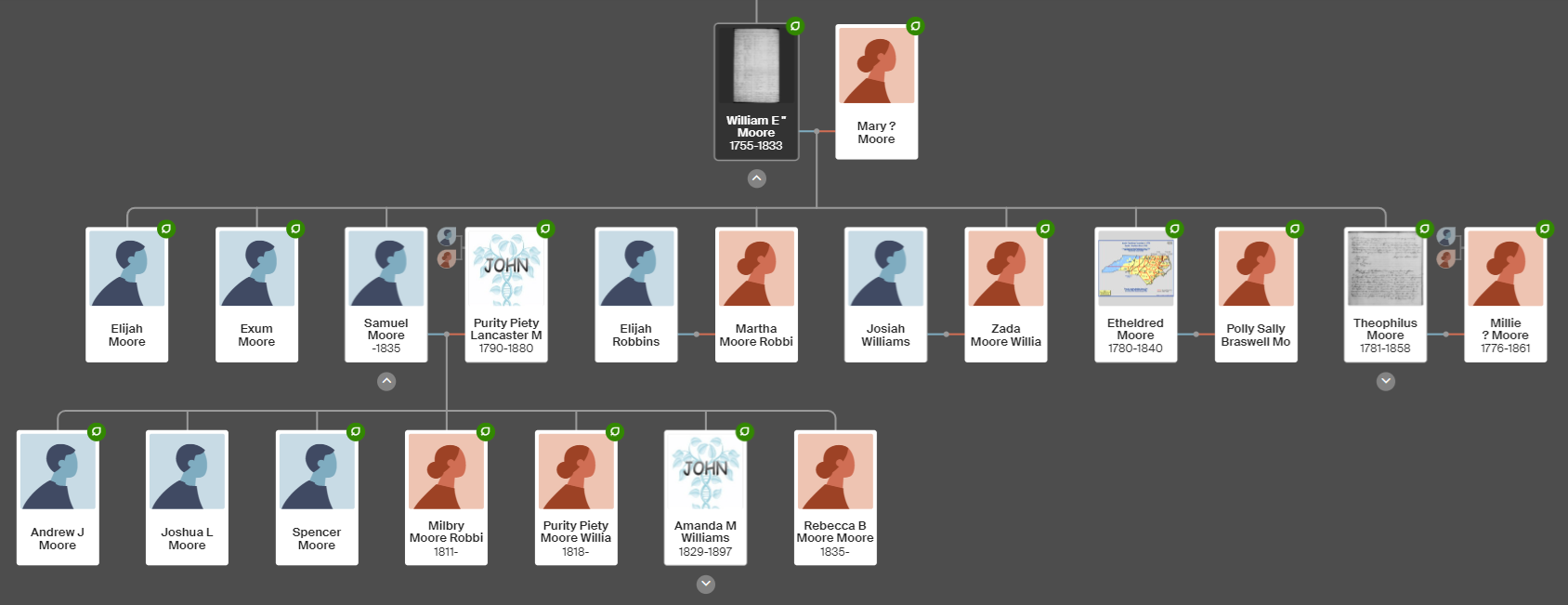
We were intrigued to see a Thru Line hint for Rebecca Moore born 22 July 1829 in the US and died 29 Nov 1897 in the US. According to her marriage license, she married Abraham Moore on 24 Nov 1835 in Edgecombe, NC, who appears to be her first cousin. Her parents were Samuel Moore (died 1835, documented by will) and Purity Piety Lancaster Moore (born 1790 in North Carolina and died 1880 Edgecombe County, NC). With all of those Moore surnames and a DNA match, we were thrilled to find this connection!
Samuel’s brother was a name we had run across before – Etheldred Moore (born 1780 and died 6 Jun 1840 Edgecombe, NC) – and their father was William Elijah Moore, born 1755 and died 1833, all in Edgecombe, NC. Further research found that William Elijah Moore’s father was James Moore (1729-1789) and his grandfather was Joseph Berringer Moore (1694-1757). We had extensively researched the Berringer name before and know that line to be connected to James Moore (and his son James), both of whom were governors of North Carolina in the 1700s. We know from Y-DNA that our donors are not related to this James Moore line.
Amanda Moore and her father Samuel Moore were DNA connections to one of our Ancestry DNA donors (who had also taken the Y-DNA test) and we had other ancestors near Edgecombe. Y-DNA tracks the Y chromosome from father to son for endless generations; we had previously compared the Y-DNA results and knew that the Gov. James Moore line was not our biological line (different haplogroup). Yet this Thru Line hint and documentation showed a DNA connection through Samuel Moore (died 1835).
Further digging showed that our same Ancestry DNA and Y-DNA donor had Lancaster ancestors. He (and we) are related to Amanda Moore Williams on her mother’s Lancaster side, not through her father’s Moore side. Our donor is related to Samuel Moore, not through Samuel’s Moore ancestors but through his wife’s Lancaster ancestors.
When our donor took the Y-DNA test, we joined the Moore surname project. But many of our Y-DNA matches were Howard. We found that, sometime before 1600 and possibly before the use of surnames, one of our earliest male Moore ancestors was fathered by a Howard. So we joined the Howard surname project that have confirmed this is our biological Y-DNA line.
Genealogy work is always open to discussion and subject to change. As generations leave this earth, new generations are born. Documenting our heritage is a continual work in progress; adding and collecting the data and photos of our young and continuing to search for clues that might lead us one step closer to identifying another generation of our ancestry.
 My Roots Genealogy